


 Canada
 Global
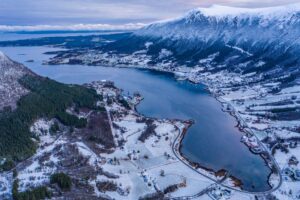
It’s early afternoon, yet the skies don a strange, purple tint. The sun has barely risen above the snow-capped peaks, but is already returning back to the horizon. Frozen grass and leaves silently burst underfoot. Standing on the cliff in the Tueneset peninsula, I have a gorgeous view over the Ålesund bay.
Nothing but mild sea murmur and shouting of the seagulls somewhere in the distance can be heard. Looking at the peaceful scenery around, one can hardly imagine any signs of war. But this is the view the German artillery battery had from a defensive position in Tueneset way back during WW2.
It was early March, 1942. It had been exactly two years since the German’s lightning-fast invasion of Norway. World War II had reached a stable phase of maintaining positions on both sides. German artillery batteries created defensive ramparts at the mouth of the fjords – the gates to the Norwegian territory. Monsters Tirpitz and Bismarck also arrived to prevent the invasion of the Allies from the Atlantic and to intercept Russian and British supply convoys.
Both cruisers were floating fortresses on their own and needed safe hiding when they weren’t on a mission. The deep and narrow fjords surrounded by high mountains were the perfect solution, but even this was improved by the Germans. They cut the trees and placed them on board. By spilling chlorosulphonic acid on them, they created an artificial mist that masked huge battleships from the air. The deteriorated access for allies from the land and the strong German defense from the Atlantic resulted in limited reach from any side. Irregular landings of military forces, or occasional air raids were—at the time—the only effective weapon against the Germans.
In addition to Bismarck and Tirpitz, other combat and supply ships moved into Norwegian coastal waters. One of them was Konsul Carl Fisser, a steamship built in Bremen in 1914 with the original name of Jakarta. In the middle thirties it was bought by Hendrik Fisser AG to pass onto Kriegsmarine a few years later. It now supplies German positions along the Norwegian coast. At this time, Ålesund is a busy German berth, and to protect it, the Germans set up a strong artillery defense on the Tuenesed Peninsula, which effectively reaches the entire bay.
Nevertheless, on May 3rd the squadron of 15 British fighters managed to escape the artillery battery sight. The supply steamer received several heavy hits that caused a fire on board. The attempt of the lifeboats to drag him to shore failed and Fisser sank. In 1957, the Polish ship “Swiatowid” attempted to haul the wreck, but their attempt failed as well. The result? Fisser now finds peace at the bottom not far from the shore.
When the Mist Disappears
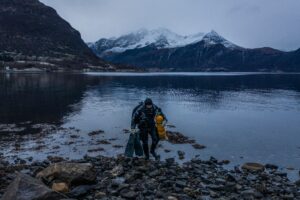
Kitted up in our BARE drysuits, we jump on the rubber boat for a short ride to the dive site. Cold, humid air stings inside the nose. Water occasionally splashes over our faces and feels like it bites our flesh. It’s not more than 2 km from the port, but since there is no buoy attached to the wreck, finding it is not easy.
Fortunately, Michal has high-quality 3D sonar on the ship, which renders the wreck on a monitor beautifully. With this visual, we can drop the rope to establish a makeshift reference. I always wondered how fishermen working on board in the freezing weather conditions of the North Atlantic feel. Now I know. I can hardly feel my hands and the rush for the dive passes away. The sun rises above the hills, yet its rays have no power, so the only way to warm ourselves is a prep routine with heavy gear.
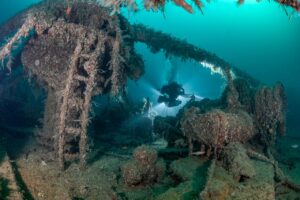
As I descend along the makeshift line, the emerald green water gradually turns grey until it finally darkens completely. I feel like a paratrooper trying to direct a landing on a German ship wrapped in that artificial fog. Falling down blindly in open water in poor visibility isn’t my greatest pleasure. When the view brightens up at a depth of 30 meters and something huge appears underneath me, it’s a relief. Approximately 10 meters of visibility allows only a certain part of the wreck to be seen, but it must be Konsul Carl Fisser. No other wreck nearby matches such dimensions.
Even though my eyes have adjusted to the darkness, my camera settings are clear proof of just how bad light conditions down here really are. Even ISO 5000 by 1/20s is not enough for proper exposure. The overall experience is intensified by the lack of light. The front of the ship stands out, while the bow sinks deep and disappears in the darkness. The bottom, at 55 meters, is not visible.
Reels, chains and ropes are firmly in place, as if they only needed to wipe off the dust to work again. Swimming above the deck toward the captain’s bridge, I spot a white anemone. It lies like a flower on a grave. She is a legend that has lived here for many years and testifies that Fisser died as a man-made structure. And just like other wrecks, it will gradually be overtaken by the sea and turned into a living part of nature.
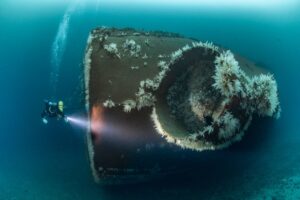
There is much more light in the middle section of the wreck. The deck rises up to 24 meters, and before the dive ends, I spot the massive stern. Although the propeller is no longer in place, the 7-meter high rudder is also an impressive piece to swim by. It’s completely covered in white and orange anemones. The wreck hides many interesting exploration areas, but for such penetrations, more dives are needed in order to get familiar with the wreck, step by step. A week of diving can be done at Fisser and still new corners can be discovered. We still have a 40-minute ascent in the open water, during which the last sun-rays disappear and the last deposits of heat will be erased.
Wrecks Galore
Ålesund can tell many interesting stories from World War II. There are more than 40 wrecks in the surrounding fjords, some still waiting to be discovered. Cruisers, aircrafts, even allegedly a German submarine rest beneath the surface. However, many of them lie in depths available only to technical divers. The fjords themselves are a wonderful phenomenon. The steep walls of the surrounding mountains continue falling at a steep angle even under water, and so the fjords are particularly deep, water-filled sinks. One can typically find depths of several hundred meters here, while the bottom in the open Atlantic, far from the coast, can be no more than 40 meters deep.
Unlike the areas in the semi-open Atlantic ocean with constantly changing currents affecting the visibility, here the water is relatively stable. The conditions are only affected by snow melting, heavy rain and summer plankton blooming.
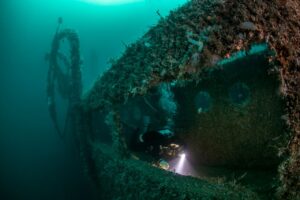
Today, the mediocre visibility is due to melting snow—not the best. I slowly get used to descending with no visual contact with the bottom, nor my buddy. A buoy with thick rope leads us down through the silty layer. Similarly to the dive on Fisser, the view opens up at 30 meters, however there is no more light to see.
The wreck lies in complete darkness on a sharply descending seabed. The bow reaches as high as 26 meters, while the propeller hits 80 meters of depth. Passing over the cargo section has an extra adrenaline feel. The beam of the dive torch reaches the inner side of the boat, while it can’t reach the other. We descend at about a 30 degree angle and float in the darkness, expecting parts of the wreck to show up at any moment.
A beautiful surprise awaits us at 60 meters. Massive masts and exhaust pipes are covered in anemones so densely that it reminds me of a blooming meadow. Colorful pipes with telescopic fans react. As rebreather divers cause only a little noise, these “flowers” stay undisturbed and open.
Who knows which other secrets wait to be discovered deep in the Norwegian fjords…